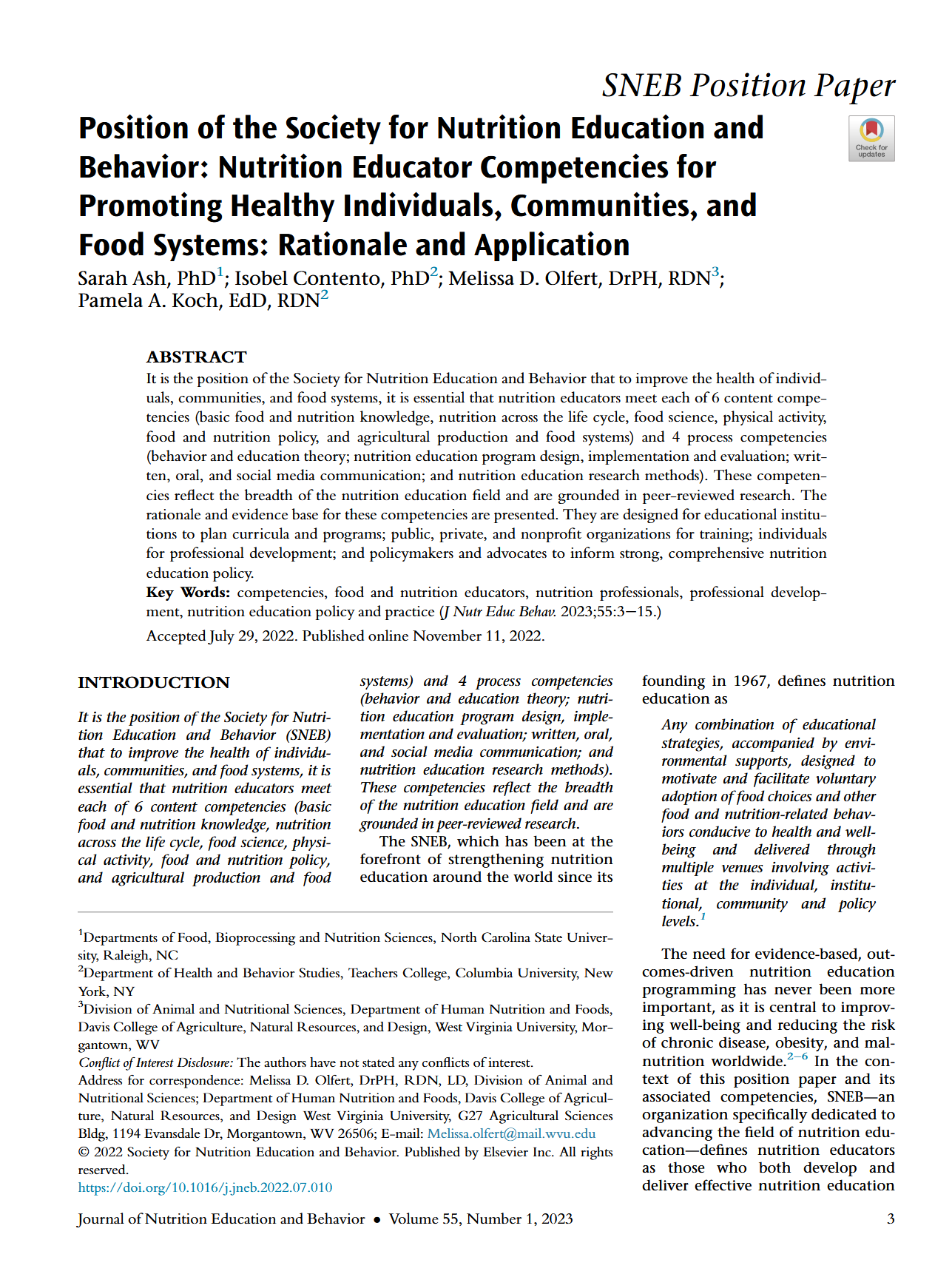
SNEB has identified 10 competencies (6 content-focused and 4 process-based) that “reflect the breadth of the nutrition education field and are grounded in peer-reviewed research.” Mastering these competencies will equip professionals with the expertise needed to transmit to populations around the world the beneficial knowledge and sustainable strategies for navigating the everchanging food and nutrition environment.
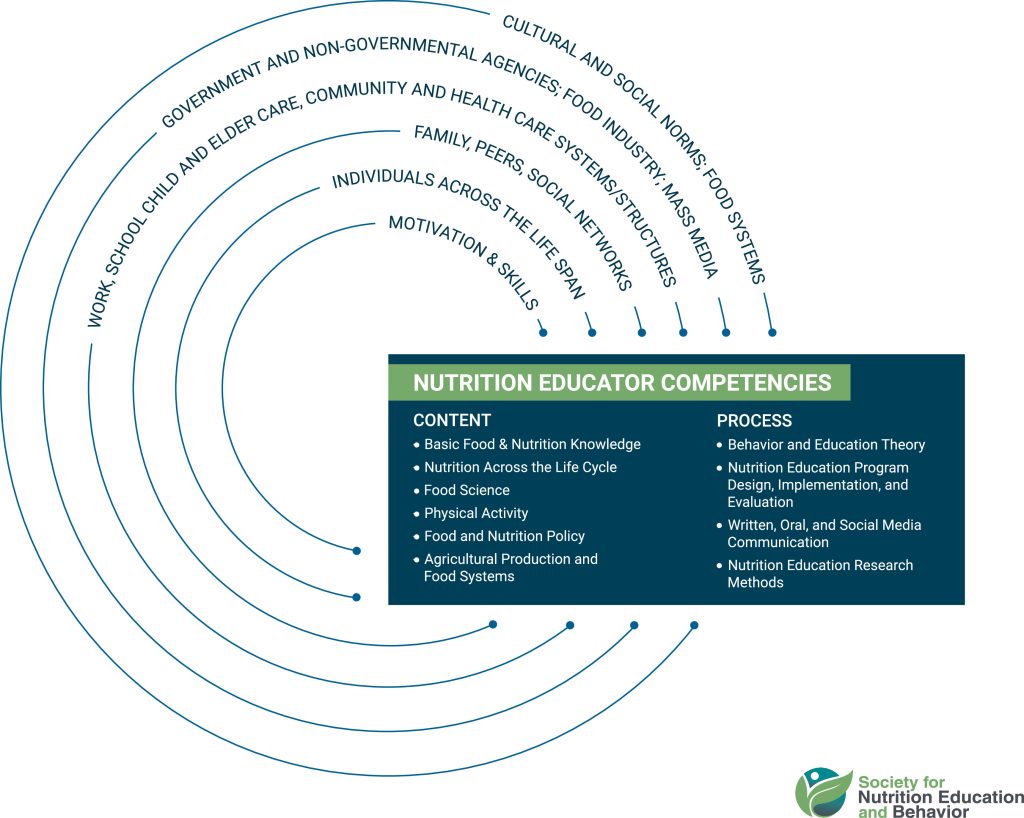
Whether you work directly in the fields of nutrition, food, public health or culinary medicine; deliver nutrition therapy or advice in patient/client care, food industry, marketing, or school and lifelong education; author nutrition-spiked popular media; research nutrition-related products and methods; or are about to embark on a health or nutrition related career, these competencies offer a vehicle to acquire or enhance your awareness of the requisite knowledge and skills to be an effective nutrition educator.
The following pages will help you to learn more about each of the 10 competencies, the competency-specific training opportunities and how you can engage with the online trainings to obtain your Nutrition Education Certificate!
Content-Focused
Provides a strong knowledge base in nutrition science including the development of nutrient references. Enhances understanding of healthful dietary patterns to promote health, reduce disease risk, and prevent diet-related diseases. Tools such as nutrition labels and dietary guidelines offer opportunities to apply nutrition expertise.
Information is presented to tailor communication, education and care to address and meet the nutritional needs of each life stage. Biochemical and physiological aspects of these needs are described, particularly for pregnancy, lactation, school age youth, adolescence, and older adults. Dietary recommendations are from multiple global and professional entities.
Functions of food ingredients, food processing methods, and culinary practices are presented to help different population groups learn about food selection, preparation, sanitation, and safety within a nutrition-focused context. These components of food and culinary literacy help individuals/learners address decisions that affect personal health.
International guidelines for physical activity and the interaction of nutrition and physical activity for health are described. Motivational practices and ideas for enhancing physical activity and healthful lifestyles are also included.
Food and nutrition policies and programs from governments, agencies, and NGOs worldwide are presented with attention to their influence on health, safety and food security. Information is provided to help educators understand food-related laws and regulations and their application to individual and community education efforts.
Issues related to food supply, eg, climate, ecological, economic, social or political influences and impacts, are addressed. Specific agricultural issues include organic crops, soil quality, regenerative agriculture and factors influencing food production, distribution and consumption. Policy development to promote food systems that are sensitive to social and ecological needs are outlined.
Process-Based
Behavior-change models, theories, and frameworks that influence nutrition education outcomes are described with attention to mediators and moderators of behavior change. Learning theories, especially those related to pedagogy and the art and science of teaching adult learners (andragogy), are discussed in context with learner needs and messaging practices.
Strategies are presented to identify evidence-based nutrition education, recognize misinformation and disinformation, avoid health halos, select appropriate communication channels, and meet learners where they are in their understanding. Skill acquisition is facilitated through globally pertinent training resources. Strategies are presented to identify evidence-based nutrition education, recognize misinformation and disinformation, avoid health halos, select appropriate communication channels, and meet learners where they are in their understanding. Skill acquisition is facilitated through globally pertinent training resources.

This competency features a systematic process for developing and evaluating a behaviorally focused program that encompasses content and delivery. Needs assessment and program management issues are incorporated into the training.
Strategies are presented to identify evidence-based nutrition education, recognize misinformation and disinformation, avoid health halos, select appropriate communication channels, and meet learners where they are in their understanding. Skill acquisition is facilitated through globally pertinent training resources. Strategies are presented to identify evidence-based nutrition education, recognize misinformation and disinformation, avoid health halos, select appropriate communication channels, and meet learners where they are in their understanding. Skill acquisition is facilitated through globally pertinent training resources.
Earn Your Nutrition Education Certificate!
Advance your career with the SNEB Nutrition Education Competencies Certificate Program — a comprehensive, self-paced learning journey—developed by members and for members—built around 10 core competencies essential to effective nutrition education.
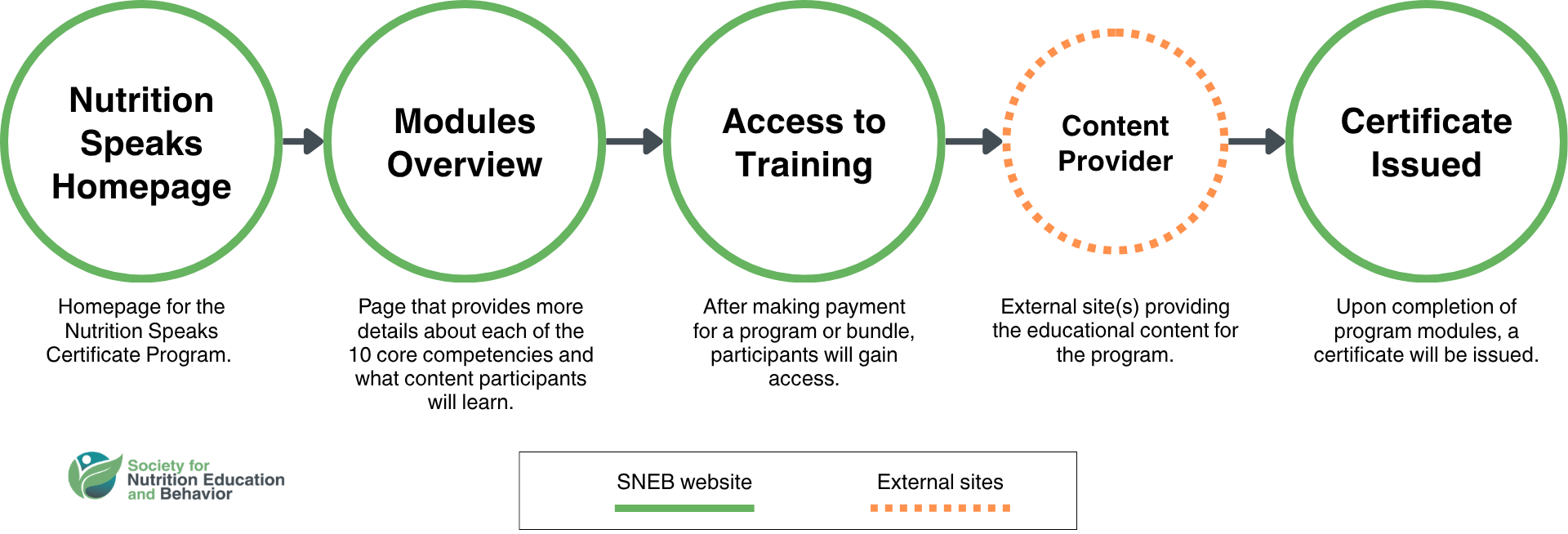
How It Works:
Choose the certificate that fits your goals, and gain instant access to your personalized program hub. From there, you’ll work through curated content from leading educational providers.
Upon successful completion of all required activities in your selected competency, you’ll receive an SNEB certificate.
Read the Position Paper
It is the position of the Society for Nutrition Education and Behavior that to improve the health of individuals, communities, and food systems, it is essential that nutrition educators meet each of 6 content competencies (basic food and nutrition knowledge, nutrition across the life cycle, food science, physical activity, food and nutrition policy, and agricultural production and food systems) and 4 process competencies (behavior and education theory; nutrition education program design, implementation and evaluation; written, oral, and social media communication; and nutrition education research methods).
These competencies reflect the breadth of the nutrition education field and are grounded in peer-reviewed research.
This project was created in partnership with these organizations

Nutrition Speak Bundles
|
|
1. Basic Nutrition Knowledge |
2. Lifecycle Nutrition |
3. Food Science |
4. Physical Activity |
5. Food and Nutrition Policy |
6. Agricultural Production & Food Systems |
7. Behavior and Education Theory |
8. Nutrition Education, Program Design, Implementation & Evaluation |
9. Written, Oral, and Social Media Communication |
10. Nutrition Education Research Methods |
|---|---|---|---|---|---|---|---|---|---|---|
|
Nutrition Practice Leadership Designed for the Nutrition Education Community (Dietetic and Nutrition Students, Medical, dental, occupational therapy, nursing students, employees in related businesses, NGOs, culinary professionals/instructors, Extension educators, family and consumer science, teaching kitchen collaboratives) |
✅ | ✅ | ✅ | ✅ | ✅ | ✅ | ✅ | ✅ | ✅ | ✅ |
|
Nutrition Essentials Designed for the Health Sciences Community (Medical, dental, occupational therapy, nursing students. employees in related businesses, NGOs) |
✅ | ✅ | ✅ | |||||||
|
Nutrition Communication & Insight Designed for the Health Communication Professionals (Graduate students in all health sciences, technical writing, health journalism and communication students and professionals) |
✅ | ✅ | ||||||||
|
Nutrition Systems & Policy Designed for the Agriculture and Sustainability Community (Agriculture students, students and professionals in sustainability field.) |
✅ | ✅ | ||||||||
|
Nutrition for Performance & Wellness Designed for the Sports & Fitness Community (Athletes, Coaches, Personal Trainers, kinesiology students) |
✅ | ✅ | ||||||||
|
Nutrition for Performance & Wellness Designed for the Sports & Fitness Community (Athletes, Coaches, Personal Trainers, kinesiology students) |
✅ | ✅ | ||||||||
|
Early Life Nutrition Practice Designed for the Early Childhood Community |
✅ | ✅ | ✅ | |||||||
|
Bespoke Nutrition Pathway Create your own package! |